


Introduction
In early 2017, the Los Angeles County Metropolitan Transportation Authority (LA Metro) proposed the creation of a Bus Rapid Transit (BRT) system from North Hollywood (NoHo) to Pasadena. The project was brought forward as a new project under Measure M, which raised the county sales tax by a half-cent in order to fund projects that would “ease traffic, repair local streets and sidewalks, expand public transportation, earthquake retrofit bridges and subside transit fares for students, seniors and persons with disabilities” (Measure M). Bus Rapid Transit (BRT) is a bus-based public transportation system with more capacity and dependability than a traditional bus system. A BRT network often contains dedicated bus lanes and gives buses precedence at junctions where buses may interact with other traffic, as well as design elements to eliminate delays caused by riders boarding or exiting buses or paying fees. BRT intends to integrate the speed and reliability of a railway with the versatility, cheaper cost, and convenience of a bus service. In order to analyze the effectiveness of this new venture by LA Metro, it is important to look deeper at what makes these gold standard BRT systems effective. An evaluation of the principles from the North Hollywood to Pasadena BRT project shows that while it does implement many key principles, they are not distributed equally across cities.
Context
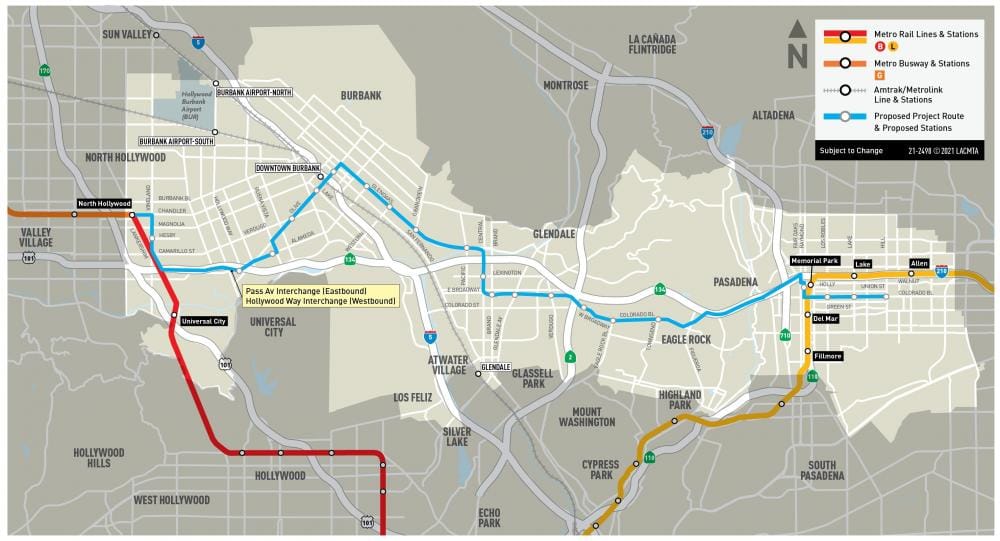
The NoHo to Pasadena BRT Corridor proposal would create an 18-mile bus rapid transit line that passes through five cities: North Hollywood, Burbank, Glendale, Eagle Rock, and Pasadena (North Hollywood to Pasadena Transit Corridor, 2022). It would bridge the L (Gold Line) and the B (Red Line). Currently, an Eagle Rock resident that needs to go west-bound to Glendale would need to take a bus to the Gold Line, connect to the Red Line at Union Station in Downtown Los Angeles, and likely take a bus to their destination. It would be very beneficial for residents who rely on public transportation. Metro estimates that by 2035, the BRT will accommodate 18,000 yearly riders (Scauzillo, 2017). The key element in the BRT project is the creation of bus-only lanes, which will allow for a fast and frequent service. Metro states that it will take less than 10 minutes to go between stations. BRT stations will have up-to-date amenities, such as better seating, lighting, trash receptacles, and real-time arrival information. The project aims to modify the standard Metro bus from that with one-door to two doors, as well as using quiet and environmentally friendly electric buses in the near future (Fact Sheet, 2020).
Aside from the technical aspirations of this project, Metro believes that the BRT will benefit bus riders and local communities. According to a 2021 Metro Board Meeting presentation, the BRT will allow for timely and convenient access to employment centers in local and regional business hubs. The project leaders believe that this ease-of-access to activity hubs will support healthy communities, help disadvantaged communities, and embolden future planning initiatives. In order to provide a smooth method for riders to navigate between stations and destinations, the BRT will connect with other transit lines (Fact Sheet, 2020).
Going forward with this project has not been an easy feat for LA Metro. Many residents of Eagle Rock, the city that connects Glendale to Pasadena, have either completely opposed the creation of single-use bus lanes in their city or have called for alternative routes that allow for continued access to street parking and other amenities. Negotiations have caused a delay in the implementation of the project. I can recall how three years ago, as a first-year student at Pasadena City College and a writer for the student-led newspaper, there were a few staff writers who covered the protests and subsequent counter-protests surrounding Eagle Rock’s refusal to implement BRT. It was a big deal then and it is now.
Analysis of BRT Principles
In order to analyze all of the principles that a BRT system should follow, I developed a categorized list of metrics. I ultimately used this data to create a score for the NoHo to Pasadena BRT project. The first set of metrics are principles that are exclusive to BRT. The second set of metrics are basic needs which can be applied to any transit system. The third set of metrics are the sustainability principles adopted by LA Metro in the Metro Countywide Sustainability Planning Policy and Implementation Plan of 2012. The full list of metrics are included in Appendices A, B, and C.
According to the Institute for Transportation and Development Policy (ITDP), a bus service is considered a BRT if it contains five basic elements: dedicated right-of-way, busway alignment, off-board fare collection, intersection treatments, and platform level boarding (What is BRT?). A BRT with a dedicated right-of-way, such as bus-only lanes, are useful for speedier travel and can eliminate the possibility of buses being late because of mixed traffic congestion. BRT adoption at the highest level might imply grade separation, exclusive right of way, and a variety of additional system enhancements. Express or skip-stop service is used by BRT systems, which indicates that the service travels on a normal route but only serves a few stations along that route. The increased distances among stations allow for more efficient service. If buses have priority signalization, a technique that allows the vehicle to synchronize with traffic lights along the corridor, BRT can be quicker than standard skip-stop service. Because of this synchronization, the bus can either receive the green signal earlier or lengthen the green cycle, allowing buses to pass through crossings faster (Bournet, 2017, p. 194).
Busway alignment is crucial so that buses are kept away from the busy curbside where automobiles are parking, standing, and turning by using the center of the roadway or a bus-only lane. The most efficient busway is a two-way center-aligned busway in the center verge of a two-way road (The Scorecard). Off-board fare collection is frequently utilized in BRT systems. When travelers pay their fares at the station rather than on the bus, they avoid the delays caused by people trying to pay on board. As for dealing with intersection treatments, turning traffic throughout the bus lane should be prohibited. It decreases bus delays caused by turning traffic. The most critical method for pushing buses through crossings is to prohibit such turns — even more crucial than signal priority. The fifth element is platform level boarding. For rapid and simple boarding, the station must be at the same level as the bus. This also allows wheelchairs, handicapped individuals, strollers, and carts to go with little delays.
BRTs are also expected to satisfy basic measures that are applicable to any transit service. Seven of these principles are directly from Steven Higashide’s observations in his book Better Buses, Better Cities (2019, p. 17). Other principles came from an article and technical guide to BRT systems published by the Online TDM Encyclopedia (Bus Rapid Transit, 2019). The first metric in this category is that the service should go where the rider wants to go. Secondly, the rider should not have to think about the service because it runs often enough. Just as well, a rider should be able to walk from the service to their final destination without difficulty. Other measures that the service should account for are the expectations from riders that it should be fast, reliable, comfortable, and affordable. Riders should not have to wait more than 10 minutes for their service to arrive. Stations and buses should provide amenities for able-bodied riders and people with disabilities. Moreover, the service should foster a sense of personal security for the riders and the service should have a crime prevention program. The system should use high quality vehicles to ensure a minimal amount of bus malfunctions or breakdowns while operating the service. The program must also have excellent customer service. Customers should have an easy and accessible way to reach LA Metro for questions and answers regarding their service. In addition, riders should be able to easily find information about the service through different mediums. For instance, any relevant information that is shown on LA Metro’s website should also be available at the stations and bus stops, preferably in more than one language. In order to boost ridership and raise public awareness about their new transit option, the service provider should promote their transit system through marketing strategies that target the cities where the service runs through.
Projects under the helm of LA Metro must follow their three sustainability principles (Los Angeles Metro, 2020, p. 19-20). All principles have social, economic, and environmental priorities. The first principle is to “Connect People and Places”. The social priority is to provide access; the economic property is to bring prosperity; the environmental priority is to have green modes of transportation available for riders. In order to provide strong access to riders, the BRT project should reduce travel times and enhance travel options by integrating land-use with transportation planning. To bring prosperity to communities, residents' transportation expenditures should be reduced. They will have the mobility they need to boost their economic competitiveness. Third, having a range of green modes of transportation will minimize criterion pollutants, greenhouse gas emissions, reliance on foreign energy, and promote clean mobility solutions. The second principle is to “Create Community Value”. The social priority is to create healthy neighborhoods; the economic priority is to promote community development; the environmental priority is to foster urban greening. Creating healthy neighborhoods can be achieved by improving public health through increasing traffic safety, reducing pollution exposure, and creating infrastructure for active transportation. Community development is possible by creating transportation infrastructure that encourages infill growth, strengthens community identity, and supports social and economic activities. Lastly, urban greening can be stimulated by improving and restoring natural systems to help communities, animals, and ecosystems cope with the effects of transportation developments. Metro’s third sustainability principle is to “Conserve Resources”. The social priority is to have context sensitivity; the economic priority is to ensure productive systems; the environmental priority is to foster environmental stewardship. In terms of context sensitivity for the social priority, the BRT project must enhance the distinctive characteristics of Los Angeles County's communities by implementing policies that are tailored to the local and regional circumstances and encourage investment in existing neighborhoods. System productivity can be achieved by increasing the efficiency of the multimodal transportation system and maintaining its long-term viability. Environmental stewardship can be cultivated by planning and promoting transportation innovations that conserve resources and materials by reusing, recycling, and repurposing them.
Evaluation
I evaluated the NoHo to Pasadena BRT Corridor using a five point scale. A “5” score means that the project fulfilled the principle, a “2.5” score means that the principle was partially fulfilled, and a “0” score means that the principle was not addressed or fulfilled at all. It can be tricky to adequately evaluate this project given that LA Metro will implement certain metrics in some areas of the corridors and neglect to do so in others. Overall, the project received a score of 80 / 105.
Beginning with the BRT-specific principles, the project earned a score of 78%, or 27.5 out of 35. The project will undoubtedly create a network with a dedicated right of way, off-board fare collection, intersection treatments, and modal integration. However, the program received a score of 2.5 for three metrics in this category: busway alignment, platform-level boarding, and high quality bus stations near transit-oriented development (TOD) regions. These problems were made clear by the Beautiful Boulevard Coalition of Eagle Rock, who pointed out that Metro has chosen to omit notable BRT features. Joe Linton’s article for StreetsBlogLA highlighted their concerns: “The Downtown Eagle Rock BRT station is poorly located in an area between gas stations instead of in the walkable commercial center at Caspar Ave. Metro is not providing access for Eagle Rock small businesses to Metro’s Business Interruption Fund even though project implementation may significantly impact vulnerable small businesses. Metro is not committing to incorporate central boarding platforms and using BRT-style buses that board from both sides. Metro has an option that uses right-side boarding buses that result in long separations between eastbound & westbound stations” (2021). For these reasons, the three metrics received a partial score.
Of the 11 basic needs that any transit system should follow, the NoHo to Pasadena BRT scores 40 out of 55, or a 72%. The BRT project shines in six metrics of the basic needs category: it will run frequently, it will be fast, it will be reliable, the rider can walk conveniently from the service to the final destination, the program will use high quality vehicles, and LA Metro will provide accessible information for riders. In four metrics, the BRT program will likely be a hit or miss. These include having the service go where the rider wants it to go, the service being comfortable and safe, the service being affordable, LA Metro providing excellent customer service, and adequate marketing. Little is known about how much the BRT will cost riders, or even if there will be fare integration with other services. In addition, fares are subject to change.
For the three sustainability metrics utilized by LA Metro, the BRT project received a score of 12.5 out of 15, or 83%. The project will fulfill two principles, “Connect People and Places” and “Conserve Resources”, as well as their social, economic, and environmental priorities. Where Metro struggles to receive a full score is “Create Community Value”, where they strayed from their economic priority of community development in certain regions. Certain stations, such as those in Eagle Rock, have been planned to be built blocks from activity hubs. While including a new transit option could stimulate economic activity in locations that have been deemed convenient for Metro, it would likely not be convenient for the ridership.
Recommendations
Based on the evaluation, LA Metro can improve in ten areas: busway alignment, platform-level boarding, high quality bus stations near TOD regions, allowing the service to go where the rider wants it to, service feeling comfortable and safe, affordability, high quality vehicles, customer service, marketing strategies, and creating community value. Several of these metrics can possibly be alleviated by allowing greater transparency, such as the price of fares. Metro should state clearly what the price of the BRT ride will be; no documents offer any insight as to the price, or whether it will be similar to the other BRT systems in the county. Moreover, Metro does not fully commit to making the BRT a safe and comfortable environment. While robberies have been dropping in LA County public transit, homicide is on the rise (Mejia, 2021). LA Metro should implement safety officers or Metro ambassadors into each cab in order to properly report and prevent crime. In addition, Metro should promote community value around the BRT system. While public transit should be viewed as an adaptable public infrastructure for residents, Metro should promote the BRT as a service that is here to stay. Policymakers should not let the NoHo to Pasadena BRT become just another Los Angeles city bus. It should set an example for the future. Therefore, LA Metro must do everything in its power to make this BRT project reliable, efficient, and affordable.
The Technical Study by LA Metro discovered six challenges that the BRT project will encounter (Noho to Pasadena Technical Study: Chapter 2, 2020, p.44). The researchers studied existing streets and highway lanes within the NoHo to Pasadena Corridor. They found that the project may not satisfy several of the proposals that have been touted by Metro in their board meetings, community forums, and fact sheets. Metro Express Line 501 and LADOT Commuter Express Line 549 both have limited service frequency and/or destinations. There may be an inadequate connection to important activity centers inside the corridor zones. Transferring to different bus lines in order to get to different activity areas will be challenging as well. In addition, there are presently no designated bus lanes for existing bus services. Increased transit trip times may be difficult to achieve due to heavy rush hour traffic on the freeway corridor and local streets. The ability to attract potential transit users is hampered by inadequate station facilities and limited pedestrian/bicycle access. The study also pointed out that existing transit services are limited in their efficacy due to physical and operational problems within the corridor's study region. Implementing a premium transit system that enhances access to major locations and reduces travel times can address the physical and operational constraints that have diluted the market presence of current transit systems. The inclusion of a premium BRT that links riders to significant activity hubs might attract more choice riders who would otherwise drive but consider taking public transportation.
Conclusion
While the North Hollywood to Pasadena BRT Corridor did not perform perfectly in 10 of the 21 principles that were analyzed, the history of the project has allowed me to see that it is not so easy to achieve a gold standard without disrupting the status quo and enacting big changes. Planners, policymakers, and local residents must work within the confines of infrastructure that has stood still for decades. We are given a set of parameters, a list of rules to follow, all of which are nearly impossible to bend. Shortcuts to success are not easy in American society, a country built upon the idea of compromise. Reading about this project has left me impressed with how Metro handled the development thus far. Nevertheless, there is still much work to be done. While input from ITDP has shown to be an effective tool for promoting BRT discussion, LA Metro should continually listen and prioritize voices from their residents and those who use public transit to get around. Planners and policymakers involved with implementing BRT systems have had their fair share of criticisms with ITDP, such as their inability to stay unintrusive. Some have questioned why TransCarioca and Rede Integrada de Transporte should be the gold standard for evaluating future BRT proposals. Any discourse of BRT development in cities involves ITDP, which does not allow for a diverse set of opinions from local residents that are most familiar with their neighborhoods. Most cities in the United States will not come close to converting four general-purpose transport lanes to bus-only infrastructure. In sum, many planners believe that the ITDP has set the bar too high by not accommodating local flexibility (Totten, 2014). Perhaps one of the best things that the ITDP brings to the table is in the organization’s nomenclature: international. Americans should venture past our own standards and those of the gold standard cities to reinvigorate the idea of American ingenuity.
References
Bournet, M. G. (2017). Land Use, Travel Behavior, and Disaggregate Travel Data. The Geography of Urban Transportation, 164–195.
Bus Rapid Transit. Online TDM encyclopedia - bus rapid transit. (2019, March 21). Retrieved March 2, 2022, from https://www.vtpi.org/tdm/tdm120.htm
Bus Rapid Transit Service Design - American Public ... (2010, October). Retrieved March 3, 2022, from https://www.apta.com/wp-content/uploads/Standards_Documents/APTA-BTS-BRT-RP-004-10.pdf
Fact sheet. Dropbox. (2020). Retrieved March 16, 2022, from https://www.dropbox.com/sh/rpl4ejabbswquzn/AAD-w0fei0vFG2Q89HIt8EkWa/Fact%20Sheet?dl=0&preview=NohoToPas_BRT_Corridor_factsheet_Fall2020.pdf&subfolder_nav_tracking=1
Fonseca, R. (2021, May 25). Eagle Rock Remains A Bus Lane Battleground As Metro Takes Step To Put Project On Colorado Boulevard. LAist. Retrieved March 2, 2022, from https://laist.com/news/transportation/la-metro-rapid-bus-project-north-hollywood-pasadena-eagle-rock
Higashide, S. (2019). Better Buses, Better Cities. Island Press/Center for Resource Economics.
Los Angeles Metro. (2020, October 9). Energy Resources Technical Report. North Hollywood to Pasadena BRT Corridor P&E Study. Retrieved March 4, 2022, from
https://files.ceqanet.opr.ca.gov/252411-3/attachment/ZoZoY5BgGX5xqVxgLUQMbt3L_DQ9qw4WK2QJ3rpfztfUIaAIXWnW6Uak5blfrq6GwD0UTqDzJ7t3Ujcs0
Linton, J. (2021, March 31). Advocates urging support for a better bus rapid transit for Eagle Rock at hearing this Thursday. Streetsblog Los Angeles. Retrieved March 4, 2022, from https://la.streetsblog.org/2021/03/30/advocates-urging-support-for-a-better-bus-rapid-transit-for-eagle-rock-at-hearing-this-thursday/
Measure M. LA Metro. (2022, January 31). Retrieved March 2, 2022, from https://www.metro.net/about/measure-m/
Mejia, B. (2021, November 28). Crime on L.A. trains, buses rises as riders return: 'poor people are suffering the most'. Los Angeles Times. Retrieved March 16, 2022, from https://www.latimes.com/california/story/2021-11-28/as-pandemic-eases-l-a-trains-and-buses-see-one-downside-of-return-to-normalcy-a-rise-in-crime
Noho to Pasadena Technical Study: Chapter 2. Los Angeles Metro. (2020, October 20). Retrieved March 4, 2022, from https://www.dropbox.com/sh/rpl4ejabbswquzn/AADrzuuA-8bnoSjyrCKOR3sua/Reports/Technical%20Study/NoHo%20to%20Pasadena%20Technical%20Study?dl=0&preview= NoHo_to_Pasadena_BRT_Corridor_Technical_Study-Chapter_2.pdf&subfolder_nav_tracking=1
North Hollywood to Pasadena Transit Corridor. LA Metro. (2021, October 28). Retrieved March 2, 2022, from https://www.metro.net/projects/noho-pasadena-corridor/
Scauzillo, S. (2017, August 30). New Busway from North Hollywood to Pasadena Moves Step Closer to Reality. San Gabriel Valley Tribune. Retrieved March 2, 2022, from https://www.sgvtribune.com/2017/03/23/new-busway-from-north-hollywood-to-pasadena-moves-step-closer-to-reality/
Sharp, S. (2017, February 1). New details for the proposed North Hollywood - Pasadena BRT line. Urbanize LA. Retrieved March 2, 2022, from https://urbanize.city/la/post/new-details-proposed-north-hollywood-pasadena-brt-line
The Scorecard. Institute for Transportation and Development Policy. (n.d.). Retrieved March 16, 2022, from https://www.itdp.org/library/standards-and-guides/the-bus-rapid-transit-standard/the-scorecard/
Totten, J. (2014, April 16). Critique of the ITDP's BRT scorecard. streets.mn. Retrieved March 16, 2022, from https://streets.mn/2014/04/15/critique-of-the-itdps-brt-scorecard/
Transit Corridor. National Association of City Transportation Officials. (2015, July 24). Retrieved March 2, 2022, from https://nacto.org/publication/urban-street-design-guide/streets/transit-corridor/
What is BRT? Institute for Transportation and Development Policy. (n.d.). Retrieved March 4, 2022, from https://www.itdp.org/library/standards-and-guides/the-bus-rapid-transit-standard/what-is-brt/
Appendices
A: BRT Metrics
| BRT Requirements | Color Score | Numeric Score |
| Dedicated Right-of-Way | 5 | |
| Busway Alignment | 2.5 | |
| Off-board Fare Collection | 5 | |
| Intersection Treatments | 5 | |
| Platform-level Boarding | 2.5 | |
| High quality bus stations, with TOD in nearby areas | 2.5 | |
| Modal integration (services coordinated with other transit facilities) | 5 | |
| Total Score | 27.5 / 35 |
B: Basic Transit Metrics
| Basic Transit Requirements | Color Score | Numeric Score |
| The service goes where you want to go. | 2.5 | |
| The service runs frequently enough that you don't have to think about it. | 5 | |
| The service is reasonably fast. | 5 | |
| The service is reliable (you don't have to worry about major delays). | 5 | |
| You can conveniently walk from the service to your final destination. | 5 | |
| The service is comfortable and feels safe. | 2.5 | |
| The service is affordable. | 2.5 | |
| High quality vehicles. | 2.5 | |
| Excellent customer service. | 2.5 | |
| Convenient user information. | 5 | |
| Marketing programs. | 2.5 | |
| Total Score | 40 / 55 |
C: Metro Sustainability Metrics
| Sustainability Metrics | Color Score | Numeric Score |
| Connect People And Places | 5 | |
| Create Community Value | 2.5 | |
| Conserve Resources | 5 | |
| Total Score | 12.5 / 15 |