


Introduction
Was cannabis traded on the ancient Silk Road? After collecting data from dozens of historical archeological studies and using spatial analysis, the answer becomes even more fascinating. Before we dive in, a brief history lesson is needed. Humans have quite a long history with cannabis and their derivatives, spanning thousands of years and multiple continents. In ancient times, the plant was used to manufacture paper and textiles. It served a ceremonious purpose for Eastern religions and their traditions. Unsurprisingly, it was used for personal consumption, although the degree of its popularity is uncertain. In the 21st century, while some countries have legalized the sale and consumption of cannabis, it is still overwhelmingly prohibited and regulated. The taboo surrounding cannabis is a historically recent sentiment. For most of human civilization, it was not regulated or prohibited. In fact, as we have come to find, cannabis was an important commodity. Through our research into this topic, we discovered that many ancient cannabis sites align with the Silk Road and historical sub-routes. In this study, we analyzed the proximity of ancient trade routes to cannabis sites and the potential impact of elevation on cultivation.
Data Collection
Cannabis Locations
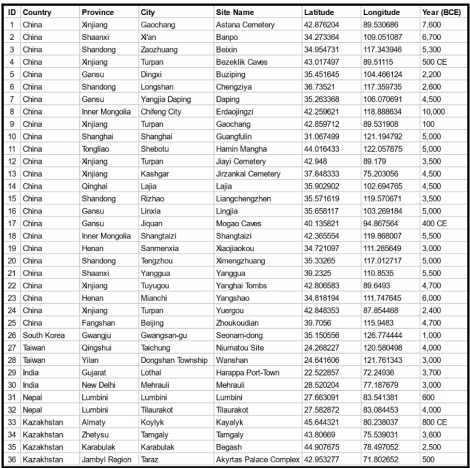
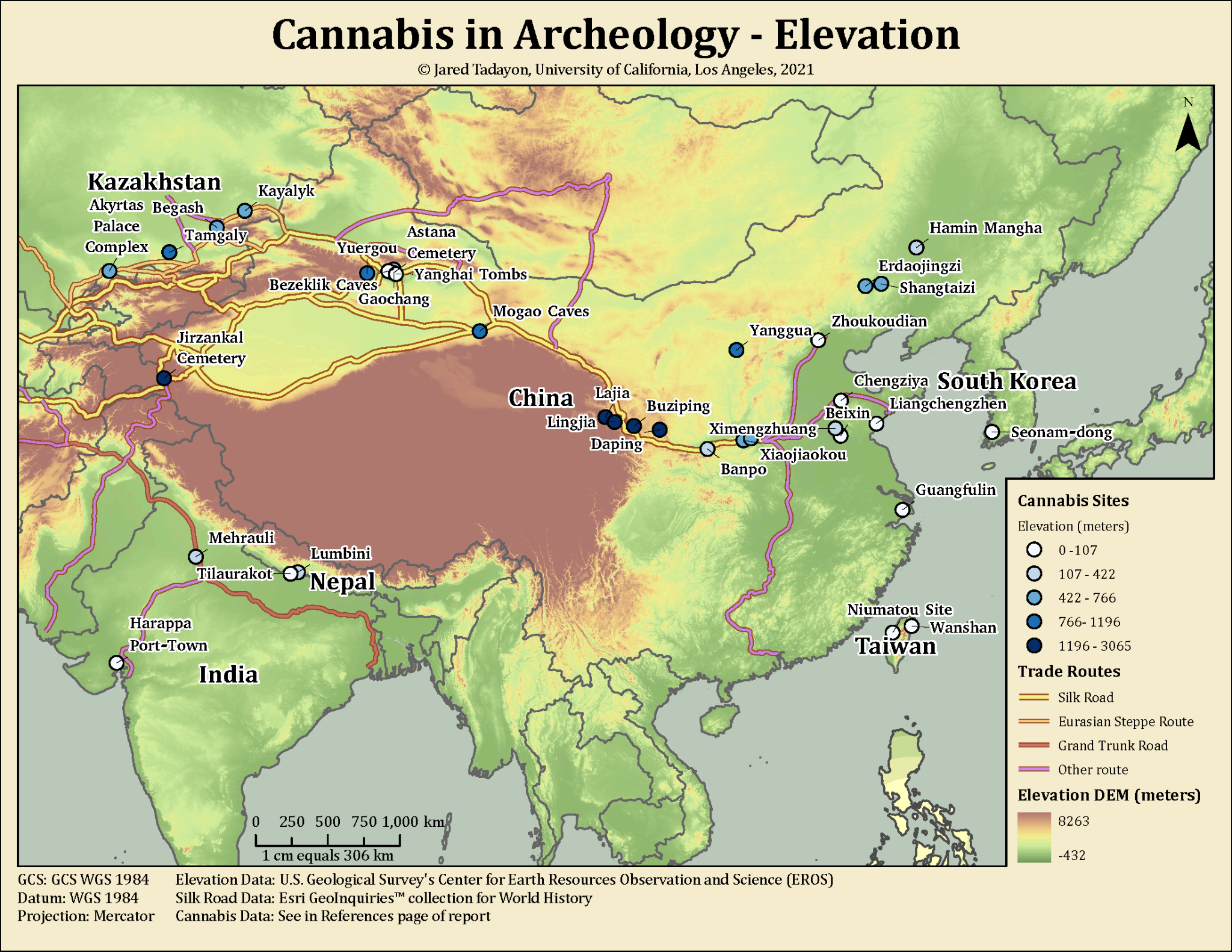
We gathered the data by examining dozens of scientific articles and books pertaining to plant and seed archeology in East Asia. As shown on the maps below, the dots mark the coordinates for every known archeological site where cannabis was present, through either their seeds or conversion to textiles. In total, we sifted through 30 pieces of literature to acquire data on cannabis remnants. A large number of scientific publications covering these sites have not been fully translated. In certain situations, governments have limited the accessibility of data concerning cannabis. Some researchers were confident that the sites were cultivation farms in ancient times because of the unusually large quantity of cannabis seeds. As the most abundant type of plant fossil, seeds can be fossilized through local animal populations. Naturally, animals may collect and carry vegetation for their nests. In colder seasons, animal urine can solidify and preserve seeds for up to 10,000 years.
Silk Road Routes, Elevation, Country Shapefiles
The shapefile of the Silk Road route and sub-routes were utilized from Esri GeoInquiries World History. We downloaded their project file and loaded it into ArcGIS Pro. The project file included other useful features, such as mountain peaks, oases, and geographic biomes. We excluded those features and only used their “Silk Road - Trade Routes” shapefile. We downloaded a 30 arc-second digital elevation model (DEM) of the Asian continent from the Conservation Biology Institute, which constructed their raster by utilizing data from the U.S. Geological Survey's Center for Earth Resources Observation and Science (EROS). For the country and continental outlines, we used standard publicly available shapefiles.
Analysis and Findings
Proximity
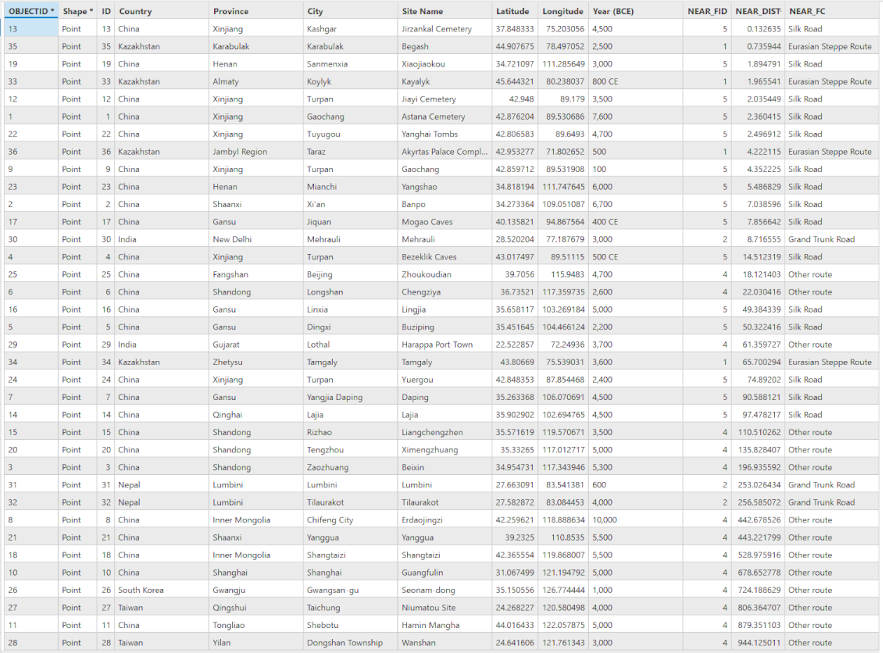
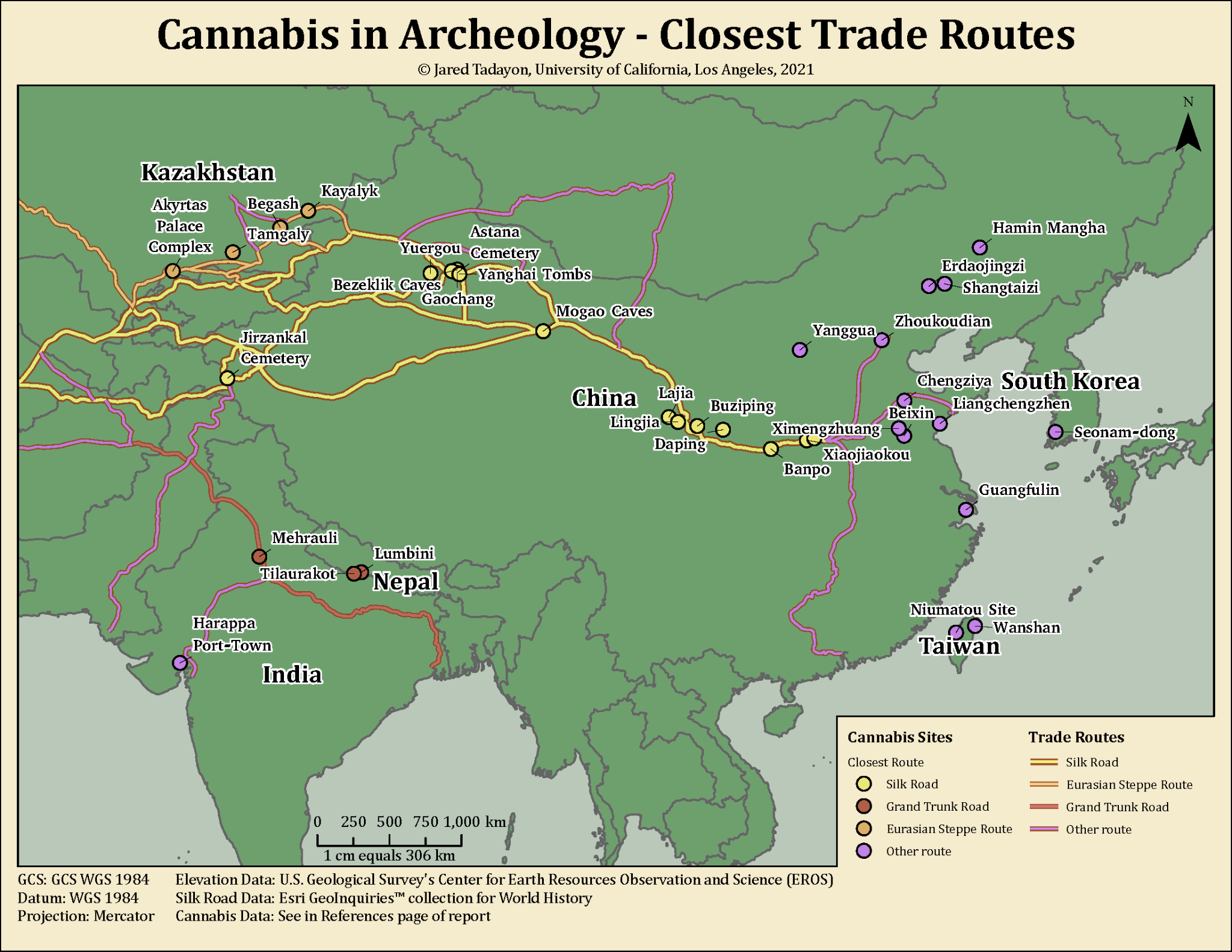
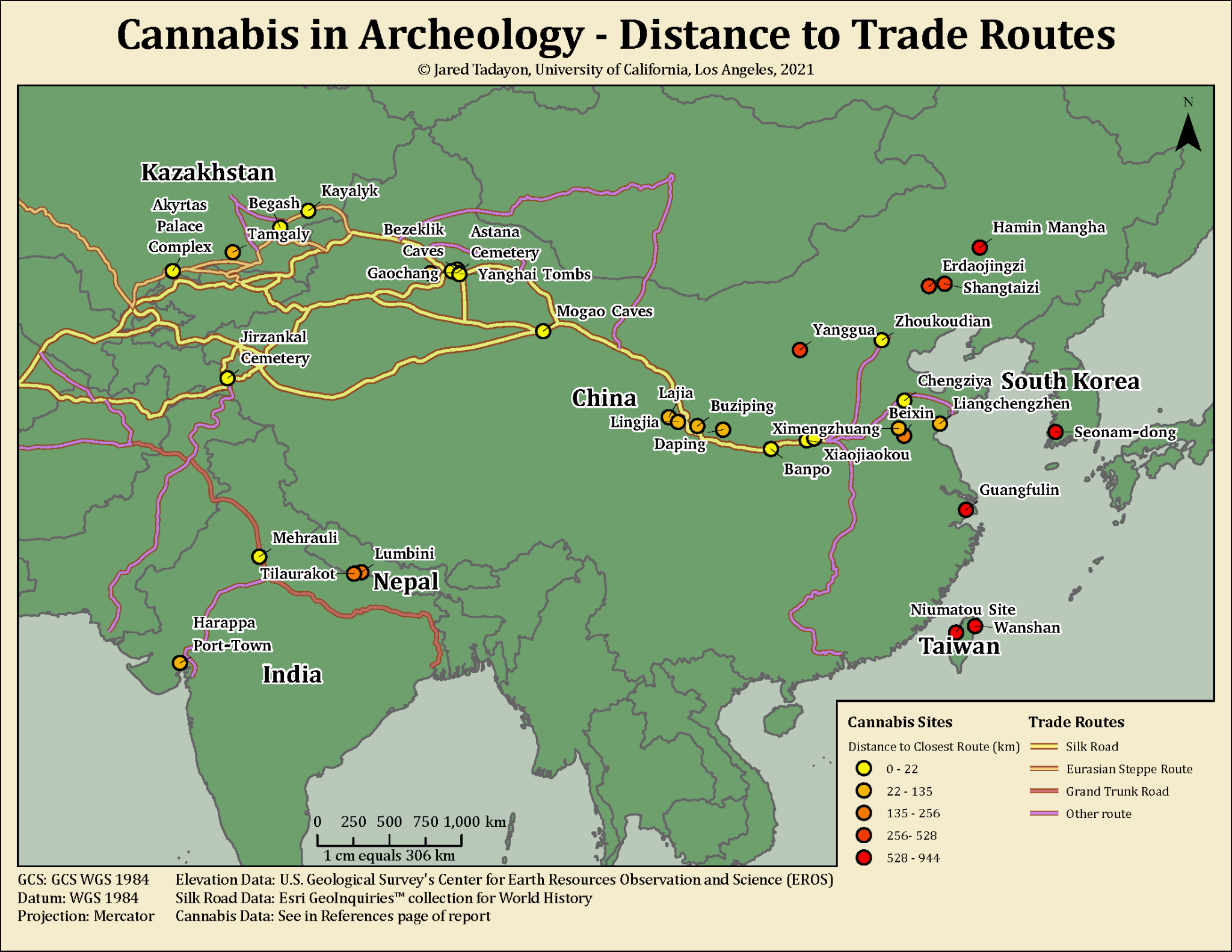
The Silk Road layer had 164 unique lines, even though there were only five trade routes. We decided to reduce that number to only five. With the Silk Road Routes layers, we used the tool “Unsplit Lines” to connect the lines that were not connected. We then used Dissolve tool to dissolved the field “NAME”. After unchecking the “Unsplit Lines” option, we deleted the inapplicable “Incense Road” column. From that, four distinct layers were constructed. The Project tool was applied to every layer of the project, to ensure a matching projected coordinate system with our map. The Near tool allowed us to find the nearest route from the cannabis sites.
Elevation
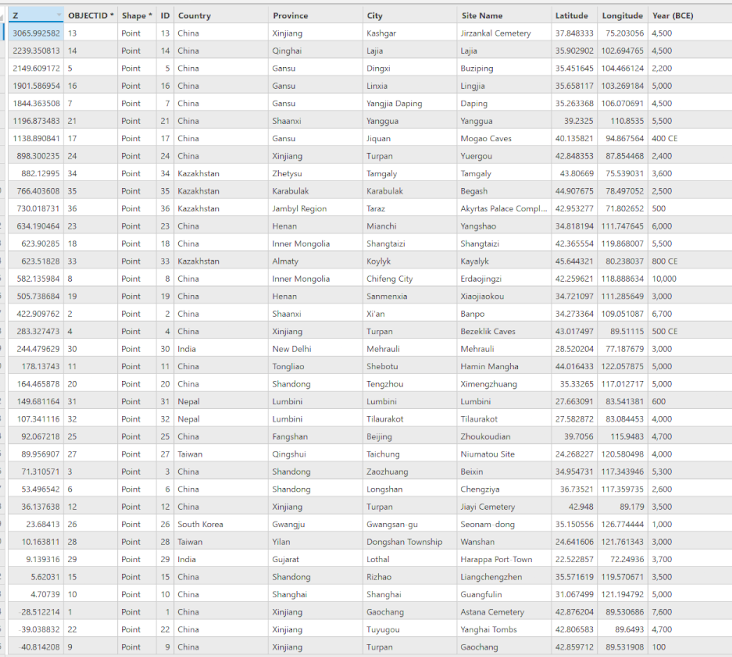
To establish elevation models, our first task was to find the Z-values of the East Asian cannabis sites. Few articles surrounding the sites neglected to include elevation data. After putting together the data, we used the geoprocessing tool “Add Surface Information” - the input feature was Cannabis Sites, the input surface was the 30 arc-second DEM, and the output property was “Z”. We had originally intended to convert this raster using the “Slope” tool, but we decided against it. The five highest and five lowest locations were in China.
Conclusion
By researching scientific studies and local literature, collecting and managing data, and performing spatial analysis, we discovered that ancient archeological sites containing cannabis were incredibly close in proximity to the Silk Road and connecting routes. Of the 36 sites, 14 neighbored the Silk Road and 12 were located along local or national routes. Four sites were found along the European Steppe Route, while three were near the Grand Trunk Road. Lastly, we analyzed their elevation properties.
References & Data Sources
An, Cheng-Bang, et al. “How Prehistoric Humans Use Plant Resources to Adapt to Environmental Change: A Case Study in the Western Chinese Loess Plateau during Qijia Period.” The Holocene, vol. 24, no. 4, 2014, pp. 512–517., https://doi.org/10.1177/0959683613520259.
Fleming, M. P. and R. C. Clarke. “Physical evidence for the antiquity of Cannabis sativa L. (Cannabaceae).” Journal of the International Hemp Association, 1998, 5(2): 80-92.
Jia, Xin, et al. “The Development of Agriculture and Its Impact on Cultural Expansion during the Late Neolithic in the Western Loess Plateau, China.” The Holocene, vol. 23, no. 1, 2012, pp. 85–92., https://doi.org/10.1177/0959683612450203.
Jia, Xin, et al. “The Transition of Human Subsistence Strategies in Relation to Climate Change during the Bronze Age in the West Liao River Basin, Northeast China.” The Holocene, vol. 26, no. 5, 2016, pp. 781–789., https://doi.org/10.1177/0959683615618262.
Kibblewhite, Mark, et al. “Predicting the Preservation of Cultural Artefacts and Buried Materials in Soil.” Science of The Total Environment, vol. 529, 2015, pp. 249–263., https://doi.org/10.1016/j.scitotenv.2015.04.036.
Li, Hui-Lin. “An Archaeological and Historical Account of Cannabis in China.” Economic Botany, vol. 28, no. 4, 1973, pp. 437–448., https://doi.org/10.1007/bf02862859.
Park, Jungjae, et al. “Pollen and Sediment Evidence for Late-Holocene Human Impact at the Seonam-Dong Archeological Site, Gwangju, Korea.” Review of Palaeobotany and Palynology, vol. 193, 2013, pp. 110–118., https://doi.org/10.1016/j.revpalbo.2013.01.012.
“Stone-Walled City-Site of the Lower Xiajiadian Culture at Sanzuodian in Chifeng City, Inner Mongolia.” Chinese Archaeology, vol. 8, no. 1, 2008, https://doi.org/10.1515/char.2008.8.1.113.
Zhou, Xinying, et al. “Early Agricultural Development and Environmental Effects in the Neolithic Longdong Basin (Eastern Gansu).” Chinese Science Bulletin, vol. 56, no. 8, 2011, pp. 762–771., https://doi.org/10.1007/s11434-010-4286-x.