


Hidden in the grassy hills of rural San Diego County, the Cuyamaca Cypress is one of California's native conifer species. Living in a historically dry region with wildfires aplenty has been a disastrous challenge for these cypresses. The tree adapted a fascinating response to protect it's seeds against fire and heat. Yet the frequency and scale of wildfires in the 21st century has nearly wiped them off the landscape. Recent estimates point to a total natural population between 30 and 40.
Scientific Name
With the binomial nomenclature Hesperocyparis stephensonii, the cypress belongs to family Cupressaceae, the order Pinales, and the class Pinopsida. The taxonomy of H. stephensonii has changed several times in recent years. It was previously identified as Cupressus stephensonii, which belongs to the genus Cepressus. While the two are often used synonymously by scientists, Hesperocyparis represents New World species while Cupressus represents Old World Species.
The International Union for Conservation of Nature included the tree on their Red List of Threatened Species. It briefly notes that scientists are not in agreement over tree's taxonomic status.
Taxonomic description of the plant
The Cuyamaca Cypress is a conifer tree classified as a California cypress. It can reach heights between 10 to 16 meters tall, with a crown spread up to 10 meters. The diameter at breast height is is 70 cm. With a notable cherry-red color, the trunk is straight and the bark is exfoliating, narrow, and flat. The branchlets range from 10 to 20 mm long and have a thickness of approximately 1.52 mm. Leaves that are less than one year-old are round, typically 1 mm long and 1 mm wide. As the branchlets grow and ages, leaves can become 4 mm long and a 10 mm wide. This species of cypress grow cylindrical pollen cones that contain between three and five pollen sacs – 2 mm by 4 mm in dimension. Once a pollen cone matures and expands to a 25 mm diameter, the cone will contain between 100 to 125 seeds. Unlike other cypress trees, H. stephensonii is loaded with sap and has a sticky coat.
Plant life history
As a perennial evergreen plant, spring is the fruiting time for the Cuyamaca Cypress. The resulting flower is monoecious, meaning one tree will contain distinct male and female reproductive portions. Cypresses are gymnosperms, and as such, their cones lack a coat of protection for their seeds. Interestingly, H. stephensonii is the only California Cypress that releases pollen during the summer season. As the cones age, the tree stops sending water their way and instead directs it to form new branchlets. Eventually, the once firm and rigid cone becomes weak and brittle, causing it to open up and drop their seeds. Younger cones are characterized by their grey appearance, while older cones boast a dark brown tone due to a lack of water and soil nutrients. When a fire emerges, the Cuyamaca acts quickly. With a complex pyrophytic adaptation, the cone responds to a sudden increase in temperature and heat by opening up and dispersing it's seeds.
Geographic and Climatic Distribution in California
While this species is endemic to California, similar varieties of the conifer are found in parts of Arizona and northern Mexico, such as the Cupressus arizonica. While H. stephensonii is sparsely scattered throughout Central and Southern California, their largest population remains in San Diego County. They are grouped in four distinct areas, the most recognizable being Cuyamaca Peak. Scientists from Cuyamaca Rancho State Park classify the park as a mediterranean climate and the mountains as a “transitional zone from the marine climate to the west and desert climate to the east.” Higher elevations have an average of 30 to 33 inches of precipitation annually, with lower elevations experiencing between 21 to 24 inches. Average temperatures in July range between 56 and 84°F, while January temperatures fall between 30 to 50°F.
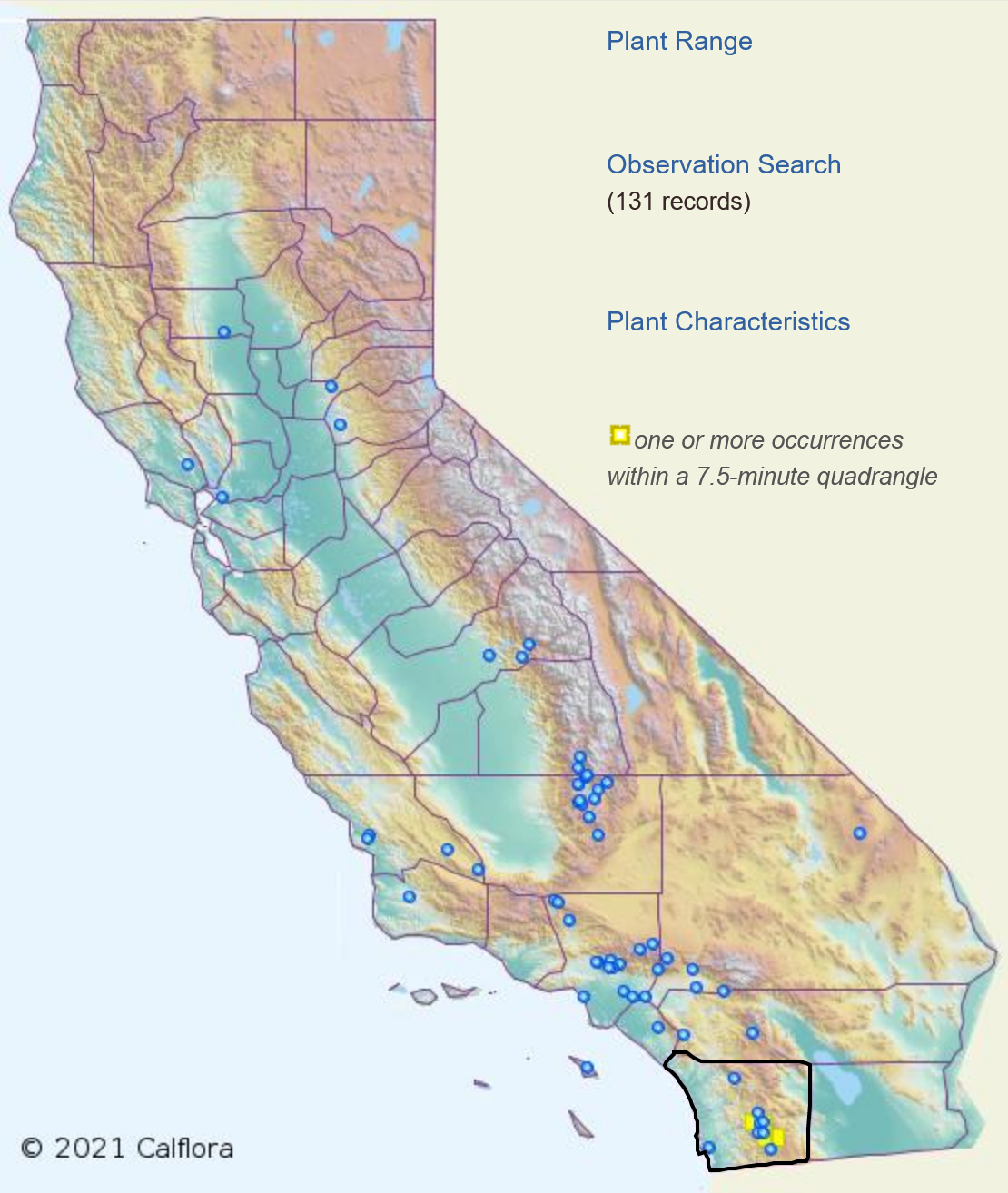
Vegetation type and habitat
The Cuyamaca Cypress lives in a the state park's mixed habitat, described by the California Native Plants Society as a “Closed-cone coniferous forest, Chaparral, Cismontane woodland, [and] Riparian forest.” Most cypresses of the Cuyamaca Mountains have been reported in King Creek, which has a chaparral environment. Although the plant requires little water, they are typically found near arroyos, where the streams can help disperse the seeds. These trees thrive on loam and sand; in most cases they have an acidic pH of five to seven. The tree can support caterpillars, butterflies, birds, and squirrels.
Challenges
As a native species of the Cuyamaca Mountains, H. stephensonii is not an invasive. It is, however, critically endangered, being listed as a CNPS List 1B, Federal Species of Concern, and a USFS Region 5 Sensitive Plant Species. The Cuyamaca Cypress is the rarest of California's several cypress species. The plant experiences blight in response to pathogenic invaders. Since the plant lives in a mostly chaparral habitat, which has dried considerably in recent years, the area is more prone to widespread fires. Before the 2003 Cedar Fire, there were only nine stands of trees in a 50-acre range of Cuyamaca Park. Jim Bartel, a U.S. Fish and Wildlife Service supervisor who researches the western cypress, surveyed one stand after the fire and discovered that one-third of the trees survived. As of 2020, there are an estimated 30 to 40 individual trees remaining.
References
"Cuyamaca Cypress, Hesperocyparis Stephensonii." California Native Plant Society. Accessed June 05, 2021. https://calscape.org/Hesperocyparis-stephensonii-().
"Cypress - A Rare Natural Community." California Native Plant Society. March 30, 2018. Accessed June 05, 2021. https://www.cnps.org/plant-science/cypress-a-rare-natural-community-6731.
Downey, Dave. "Some Rare Trees Survived Fire." The San Diego Union-Tribune, November 3, 2003. Accessed June 4, 2021. https://www.sandiegouniontribune.com/sdut-some-rare-trees-survived-fire-2003nov23-story.html
Earle, Christopher J. "Cupressus Stephensonii." The Gymnosperm Database. Accessed June 05, 2021.
Farjon, Aljos. "Cuyamaca Cypress." IUCN Red List of Threatened Species. March 16, 2011. Accessed June 05, 2021.
Field, Lisa, Lisa Gonzales-Kramer, and Larry Hendrickson. "Physical and Biological Resources Inventory." Cuyamaca Rancho State Park. August 2014. Accessed June 4, 2021.
"Hesperocyparis Stephensonii." Inventory of Rare and Endangered Plants of California. Accessed June 05, 2021. https://rareplants.cnps.org/Plants/Details/539.
"Hesperocyparis Stephensonii Calflora." Calflora. Accessed June 05, 2021. https://www.calflora.org/app/taxon?crn=11193.