


Introduction
The United States Census Bureau has nearly 30 publicly-available APIs that developers can integrate into their websites. Every decade, the U.S Census surveys Americans about their financial status, health, educational attainment, and other factors. The most recent 2020 Census was conducted in the backdrop of the COVID-19 pandemic and became imbued in political debates over a question on immigration status. Nevertheless, the Census informs the public about regional and statewide data trends. Politicians utilize population data to redraw political districts. The Census API allows users to quickly obtain data with a single command, through which large swaths of datasets are filtered to suit the relevance of the user's task. Integrating this API provides a faster means of obtaining data than sifting through the Census website.
Technical Features
The U.S. Census provides the API in three forms: html, xml, and json. As a government agency that is focused on cataloging information, the Census follows the guidelines of Project Open Data. The program intends to unify all virtual government services under one schematic for web APIs and metadata formatting. As described later in the “Workflow and Personnel” section, the data can be filtered by time, location, and a number of other variables.
Necessary Infrastructure
The technological infrastructure needed to access the Census API is a standard programming application, a web developing application, or a browser. The API can be suited neatly into a number of formats. The more important issue for a developer integrating Census API is determining the type of program where the results will flow into; proper step-by-step guides will vary depending on this. Read more on their user guide.
Workflow and Personnel
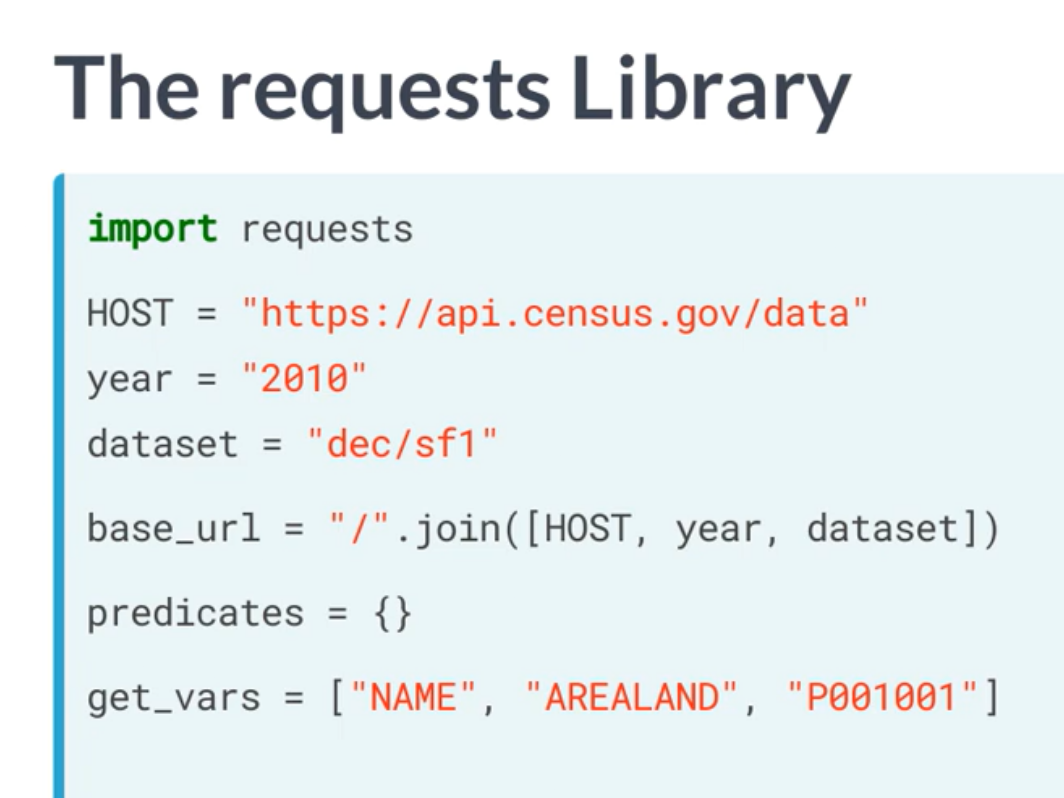
To perform an API query with U.S. Census datasets, the developer must narrow down their scope of data. Determining the specific variable and attributes they intend to include is an important first step. Next, to restrict the geographic regions, they should include a predicate. For example, &for=state:01 will limit results to Alabama, while &for=state:01,13 will limit results to Alabama and Georgia. The developer can create a predicate of string variables, such as &AGEGROUP=29, which filters data to only people age 18 years old and over. In the case of numeric strings, a great example is &PAYANN=100000. This limits the API's output to only show data where the annual payroll is equal to 100,000. A predicate for time is also apt, for example, &time=2015 will narrows results to data from 2015 only. A developer can insert these predicates into their code by using the API insertion provided by the U.S. Census. An example is https://api.census.gov/data/2019/pep/charagegroups?get=NAME,POP&HISP=2&for=state:*. As seen in the URL, it can provide data for a specific year, multiple variables, predicates, and geographies. Obtaining the API will be a simple task for those familiar with how the Census API functions. If a developer were to import Census data into a Python program, it would look similar to below:
Advantages
The information collected and organized by the Census can be of great use in nearly every field of work. Data practitioners or social scientists can draw meaningful conclusions from analyses of Census data. The API can be useful for city dashboards, as a means of maintaining historical transparency or promoting citizens to find the ways they fit into local trends. For businesses, incorporating the tool onto a website can eliminate having to flip back and forth between sites. Just as well, it is practical for quickly obtaining and inserting data into Excel worksheets. The API has been operational for over eight years and seems to be working as intended, with little issues overall.
References
(1) https://www.census.gov/content/dam/Census/data/developers/api-user-guide/api-guide.pdf